

The Simplero Changelog: Here's what we've been up to...
Reply messages in a broadcast's Replies tab now look like the messages they are, instead of a wall of blue underlined links. They're still clickable — select any reply body to open the full email in the side panel.
When a module or lesson is dripped, you can now grant access right from the course — no more hunting for the contact page and guessing which checkbox to tick.
On any dripped module or lesson, open the … menu on the drip status pill (next to View drip actions) and choose Grant access. Pick one or more contacts, or everyone with a tag or in a segment, and optio…
New modules default to names like "Module 1", so if you have more than one course, you'd see the exact same name more than once when picking a module — for example when choosing where Zoom or Simplero Live recordings should become lessons. It now shows the course name too, like "Onboarding > Module 1", so you always know which one you're picking.

The double opt-in confirmation email we send on your behalf — the one asking a new subscriber to confirm they want to hear from you — just got friendlier wording around the confirm button. The button itself now names the list too, like "Yes, subscribe me to My Newsletter." If you haven't customized this email, the new wording goes out automatically; no action needed.
Want to make it even more yours? Open Lists → pick a list → Double opt-in → Customize the confirmation email.

Messages from different people in a chat conversation used to have an oversized gap between them, making threads feel more spread out than they should. That extra gap is gone, so messages now sit closer together — similar to how messages from the same person already stacked tightly.
Open the chat icon from anywhere in your account and view a conversation with more than one person to see it.
If you've set a custom "from" name or email on a product or list, picking that product or list as recipients when you start a new broadcast now actually uses it. Before, the broadcast kept your account's default sender no matter what you picked there, and you had to start the broadcast from inside that product or list instead to get the right sender to show up.
Try it from Broadcasts → New: pick a product or list as your recipients and your sender name and email will switch to match automatically (unless you've already typed in your own).
Deleting a contact didn't actually revoke the site access they'd been granted — it just stopped them from showing up as an active contact, while their access could stay live behind the scenes. That's fixed: deleting a contact now revokes their site access immediately too.
No action needed — this happens automatically whenever you delete someone from Contacts. We've also gone back and fixed any contacts this already affected.
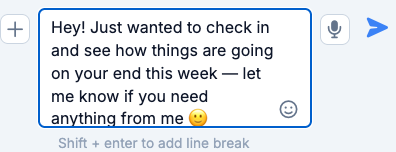
In any chat composer — Simplero Chat, an affiliate or member conversation, worksheet or event chat — a longer message could wrap right under the emoji button, making the last line hard to read. The emoji button now sits at the bottom corner of the box, and your text wraps around it instead of under it.
Try it in Affiliates → open an affiliate → Conversation, and type a longer message.
"Turn into a Landing Page" and "Turn into a Funnel" are meant for regular pages, not your site's home page or a page that has other pages nested under it in your menu. Using them on one of those could quietly strip the page of its content while it stayed live at its usual address — or show a confusing error.
Those actions now explain clearly why they can't …
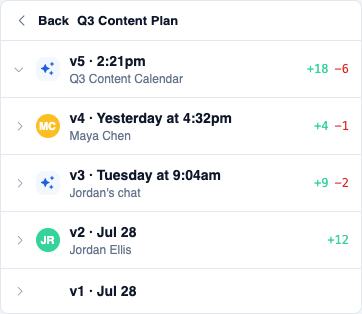
Version history on your AI Coach sources now shows who made each change: your avatar for edits you made directly, or an AI badge with a link to the chat that made the edit when the AI updated it for you. Each version also shows a friendly relative time (like "Yesterday at 4:32pm") instead of a raw timestamp, So it's easier to scan what changed and when.
Open any source in Simplero.Coach, click the ⋯ menu on it, and choose History to see it.
In the new page builder experience, clicking into a Headline, paragraph, or other text block could leave its formatting toolbar partly covered by the Row/Column/Element label above it — sometimes hiding buttons like Insert video. The toolbar now always stays on top and fully clickable.
Try it in Landing pages: open a page, turn on New page builder experience from the editor's ⋯ menu if you haven't already, then click into any text to edit it.
When Coach builds a landing page with an opt-in form, the email input now binds to your account's built-in Contact email field — the same field the page builder UI always uses. Coach will no longer invent a separate custom email field, so signups land on the real contact record and list subscriptions work as expected.
Try it: open Coach and ask for a landing page with an email opt-in form, then check the form fields in the page builder.
If a participant needed to sign a contract for an event — especially someone you registered manually rather than through self sign-up — signing could fail with a broken page instead of completing, if they reached the event from your membership site's custom domain. That's fixed: signing now works no matter which domain someone reaches the event from, and tak…
Opening a comment notification or a copied comment link on a busy forum post sometimes left you at the top of the post instead of the comment you meant.
Those links now load enough comments to find the one in the URL and scroll you straight to it — even when the thread has dozens of replies.
No settings to change: open any comment notification or “copy link” URL on a long thread to try it.
When an email to a contact was Dropped (often because the address was on an email suppression list), the contact could sit stuck with no way to clear it — Retry only showed for bounces, and even then it did not fully clear suppression.
Now:
- Dropped-from-suppression contacts show the same Retry control as bounced ones
- On the delivery report for a Dropped e…
Adding or editing a "Product category" link in your site's navigation menu could fail to save with an error, even though every other link type worked fine. That's fixed — Product category links now save and work like any other menu link.
Open Sites, open your site's editor, then click a navigation link (or add a new one) and choose Product category.
On an affiliate program's Payout tab, clicking Mark paid next to a single affiliate showed an error instead of registering the payout — you had to select the affiliate's checkbox and use Select action → Mark paid instead. The per-row button now works the same as the bulk action, marking that affiliate's owed commission as paid immediately.
Open Affiliate programs, pick a program, then Affiliates → Payout to try it.
If you set up default automations for scheduling links (things like a booking reminder email or text), they were being silently skipped whenever you created a new scheduling link — you'd have to notice they were missing and add them by hand from the link's Automations tab.
New scheduling links now automatically start with whatever default automations you've…
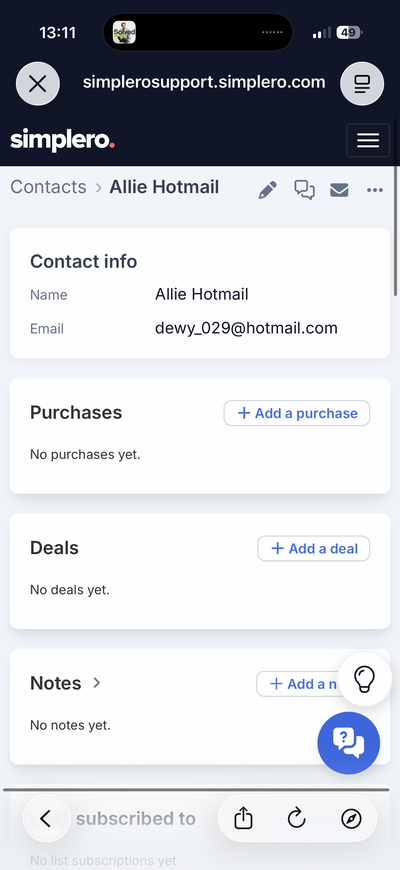
Admin pages that used to cram two columns side by side on a phone — like the event editor and other settings forms, plus your contact, purchase, and membership pages — now stack neatly from top to bottom, so labels and fields are easy to read and tap instead of squished. It's another step in making Simplero comfortable to run from your phone, and nothing changes on a computer.
Take a look at your phone: Contacts.
The Help tab used to hold both your bot and your help articles. They're now two separate tabs: Chat and Guides.
Chat also keeps every conversation a visitor has started with your bot, instead of just the one. They can look back through them and pick any of them up again.
Your bot now answers there as itself. The instructions, tone, default model and web access…
